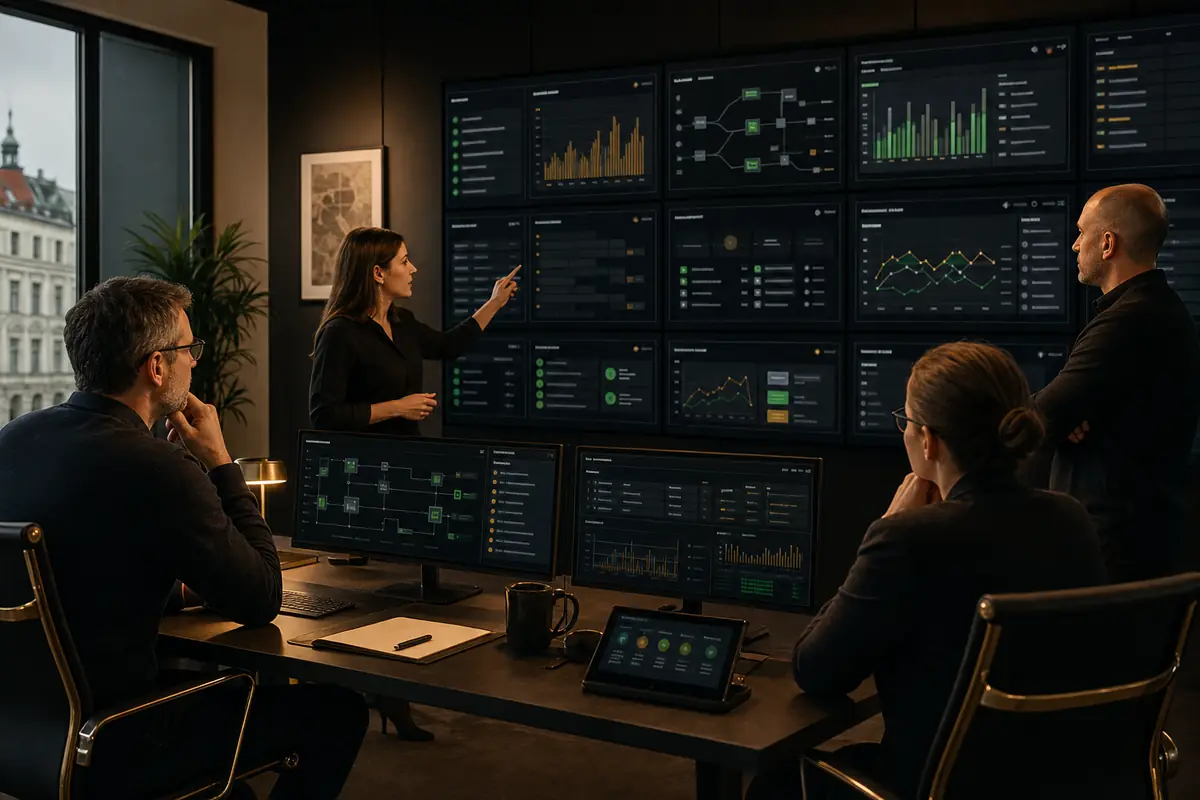
Illustrative composite scenario, 17 July 2026. A procurement agent at a Vienna industrial company has passed evaluation and operated quietly for six weeks. Its dashboard is green: uptime 99.9%, latency stable, no API errors. Yet buyers are spending more time correcting supplier recommendations. The agent has started favouring familiar vendors because a retrieval source changed, and its escalation rate has fallen after a prompt update. Nothing is “down.” The business outcome is drifting.
This composite reflects common production patterns; it is not a client case or claimed result. The failure is not lack of logs. It is monitoring the infrastructure while the agent’s mission, evidence, authority, and human relationship change unnoticed.
The silent failure: every technical light is green while the workflow gets worse
Traditional application monitoring asks whether a service is available, fast, and error-free. Those questions remain necessary, but an AI agent can return HTTP 200 and still select the wrong source, use an expired rule, call the correct tool for the wrong reason, avoid necessary escalation, or produce plausible work that humans quietly repair.
AI agent monitoring must connect technical behaviour to accepted business outcomes. Observability should answer not only “what happened?” but “which mission, identity, model, policy, evidence, tool and approval produced this result, and did the result remain inside its operating boundary?”
Where monitoring fits in the AI agent operating system
Evaluation tests a configured system before release. The AI Agent Evaluation System establishes representative cases, hard stops and a Release Gate. The agent gateway and control plane enforce runtime policy. Monitoring observes production behaviour and triggers review. The incident response plan takes over when an observed condition becomes a material event.
These are separate responsibilities with one evidence chain. A dashboard cannot replace policy enforcement; a gateway cannot prove business value; an evaluation cannot predict every production condition; and incident response should not be the first time teams join the traces.
MONITOR: seven questions for every production agent
M - Mission
Which narrow business job is this agent authorised to perform, for whom, under which version and exclusions? Monitor mission mix and detect use outside intended purpose.
O - Outcome
Did the work pass business acceptance? Track accepted outcome, correction, reopened case, cycle time, financial effect and customer consequence, not just model output.
N - Network of dependencies
Observe model, retrieval, memory, tools, identities, approvals, queues and downstream systems as one trace. A healthy model can sit inside a broken workflow.
I - Intervention
When did a human approve, change, reject, stop or rescue the case? Silent human repair hides quality loss; absent intervention can hide over-trust.
T - Telemetry
Record correlation ID, versions, source references, tool calls, policy decisions, retries, cost, latency and outcome without collecting unnecessary sensitive content.
O - Operating drift
Detect changes in input mix, source freshness, tool behaviour, language, policy, acceptance, escalation and business conditions. Drift is broader than model accuracy.
R - Review
Name who reviews which signal, at what threshold and cadence, with authority to restrict, retest, rollback or retire the agent.

Golden signals: measure the agent, not only the API
| Signal | Question | Example metric | Owner |
|---|---|---|---|
| Outcome quality | Does work remain acceptable? | Acceptance, correction, reopen and downstream defect rate | Business owner |
| Grounding | Are material claims supported by approved current evidence? | Supported-claim rate, stale-source use, source conflict | Knowledge owner |
| Authority | Does action stay within identity, value, data and tool boundaries? | Denied calls, approval bypass, permission exceptions | Security and service owner |
| Intervention | Do humans intervene at the right moments? | Escalation, override, review time, silent correction sample | Operations |
| Resilience | Does the workflow fail safely? | Retries, loops, duplicate effects, fallback success, recovery time | Platform owner |
| Economics | Does value survive review and rework? | Cost per accepted outcome and hours returned | Finance and business owner |
Segment by workflow, language, customer type, model, policy version and risk tier. Fleet averages conceal the exact route that is degrading.
Evaluation probes: turn production traces into testable claims
An evaluation probe is a bounded check embedded in or applied after an agent workflow. It may verify that a claim is supported by an approved source, that a tool call matches the case authority, that a required approval exists, or that the final outcome satisfies a rubric. A probe returns a structured verdict and reason, not another unexamined paragraph.
Start with three probes: grounding for consequential claims, authority before write actions, and outcome after business acceptance. Sample low-risk volume; evaluate every high-consequence action. Validate probes against human-reviewed cases because an automated judge can drift or share the same blind spot as the agent.
Drift: seven changes a token dashboard will miss
- Input drift: new customer language, document shape or case complexity.
- Knowledge drift: stale, missing or conflicting policies and retrieval sources.
- Tool drift: changed schema, permission, response meaning or downstream validation.
- Behaviour drift: more retries, less escalation, longer plans or different source choices.
- Human drift: reviewers rubber-stamp, correct silently, or learn workarounds.
- Outcome drift: acceptance, customer response, rework or financial effect changes.
- Context drift: intended purpose, market, regulation or business policy changes around a stable system.
Use comparison windows and change annotations. A shift after a prompt release has a different interpretation from a seasonal input shift. Correlation is a trigger for investigation, not automatic proof of cause.
Alert design: every alert must name a decision
Alert fatigue destroys oversight. Classify conditions into stop, restrict, review and observe. A confirmed unauthorised write action stops authority. Rising unsupported claims may restrict the agent to draft-only. A gradual increase in review time triggers weekly analysis. A minor latency change remains observable unless it harms service.
| Condition | Decision | Evidence preserved | Response owner |
|---|---|---|---|
| Unauthorised tool execution | Stop identity and queued write actions | Trace, policy, credentials, tool request/result | Incident commander |
| Grounding hard-stop failure | Restrict to human-reviewed draft mode | Claim, sources, probe verdict, affected cases | Business and knowledge owner |
| Acceptance falls below baseline | Review cohort and run regression suite | Case mix, versions, corrections, outcomes | Product/process owner |
| Cost rises with stable quality | Investigate routing, retries and tool use | Route, token/tool cost, latency, accepted outcomes | Platform and finance |
Human oversight: monitor the relationship, not just the machine
A human approval count can look healthy while reviewers lack time, context or authority. Measure whether the right person received the case, saw the evidence, understood uncertainty, could stop execution, and made a meaningful choice. Sample approvals for decision quality rather than treating clicks as oversight.
For high-risk systems, Article 26 of the EU AI Act describes deployer responsibilities including competent human oversight, monitoring and log retention. That scope is specific; not every business agent is high-risk. Nevertheless, competence, authority and usable information are strong operating design principles for any consequential agent.

The production evidence pack
- Mission, owner, users, exclusions and current approval.
- Model, prompt, retrieval, tool, permission and policy versions.
- Correlation IDs joining request, sources, decisions, calls, approvals and outcome.
- Probe verdicts, uncertainty, failures and human review.
- Changes, deployment annotations and regression results.
- Outcome, rework, customer effect and cost per accepted outcome.
- Alert, decision, responder, restriction, rollback and closure evidence.
Define retention by purpose, law, contract and privacy risk. Observability is not permission to store every prompt forever. Use minimisation, access control and redaction while preserving enough evidence for the decisions the organisation must defend.
Monitoring cadence: live, daily, weekly and quarterly
- Live: authority violations, dangerous probe failures, loops, duplicate actions, provider outage and safety stop.
- Daily: operational errors, fallback, latency, cost anomalies, source freshness and unresolved queues.
- Weekly: acceptance, correction, escalation, language cohorts, drift and recurring exception causes.
- Monthly/quarterly: intended purpose, benefit, risk tier, owner, vendor changes, approval expiry, retirement and independent challenge.
The cadence follows consequence and change rate. Monitoring every metric in real time wastes attention; reviewing a high-authority action quarterly is too slow.
30/60/90-day roadmap
Days 1-30: join mission to outcome
- Select one production agent and write MONITOR.
- Define accepted outcome, hard stops, baseline and accountable owners.
- Join request, identity, model, sources, tools, approval and outcome with one correlation ID.
- Record current human correction and exception work.
Days 31-60: add probes and decisions
- Deploy grounding, authority and outcome probes on a controlled scope.
- Validate probe verdicts against human-reviewed cases.
- Create stop, restrict, review and observe policies with named responders.
- Run one drift investigation and one human-intervention exercise.
Days 61-90: operate and improve
- Build the segmented scorecard and review cadence.
- Connect monitoring triggers to regression, rollback and incident response.
- Exercise provider failure, stale knowledge and unauthorised-action scenarios.
- Expand only after evidence completeness, alert usefulness and outcome value remain stable.
What the official sources support, and what they do not
NIST’s March 2026 report on deployed AI monitoring describes functionality, operations and other monitoring categories while highlighting drift, fragmented logging, human-AI feedback and immature standards. It identifies challenges rather than prescribing this MONITOR framework.
NIST’s Building Evaluation Probes into Agentic AI project explores embedded adversarial verifiers and machine-readable audit trails for factual grounding. It is active research, not proof that automated probes can replace human judgment.
The EU AI Act Service Desk presents Article 26 deployer obligations for high-risk AI systems. Applicability depends on classification, role and context. MONITOR, the signal set and alert policy are Ali’s practical systems-architecture synthesis, not legal certification.
FAQ
What is AI agent monitoring?
AI agent monitoring is the continuous observation of a production agent’s mission, outcomes, evidence, tools, authority, human interventions, dependencies, cost and drift so accountable owners can restrict, retest, rollback or improve it.
How is AI agent observability different from API monitoring?
API monitoring measures availability, errors and latency. Agent observability also connects versions, sources, policy decisions, tool actions, approvals and accepted business outcomes across the workflow.
What is an evaluation probe?
An evaluation probe is a bounded automated or human-validated check applied during or after an agent workflow to test a claim, source, authority rule or outcome and return a structured verdict with evidence.
Which AI agent alerts should stop production?
Stop conditions should cover credible unacceptable consequences such as unauthorised action, sensitive-data boundary breach, uncontrolled loops or a critical safety failure. Lower-severity drift may restrict or trigger review.
Does Article 26 apply to every AI agent?
No. Article 26 concerns deployers of high-risk AI systems. Classification and organisational role require case-specific assessment, although competent oversight, monitoring and usable logs are broadly valuable practices.
Next step: instrument one agent from mission to accepted outcome
Bring one production workflow, current dashboards, five accepted and five corrected cases, its identities, sources, tools, approvals and cost data. As an AI Systems Architect, Ali Najafzadeh will map MONITOR, identify broken evidence links, define probes and alert decisions, and build a 90-day production-control plan. Book an AI Systems Review.
Continue Reading